Suggested changes
Write the replacement code into a line comment so the agent gets an exact edit instead of a description. A suggestion is a fenced block inside an ordinary comment, so it rides along with your note, your tag and the reply thread.
Suggest a change from the comment box
Section titled “Suggest a change from the comment box”- Open a comment on a line or a range of changed lines, by clicking the line number or dragging across several (see Inline comments).
- Click Suggest change, or press
Ctrl+Gwhile the comment box has focus. This isCtrlon macOS too. - nittle inserts a suggestion fence at the cursor, prefilled with the lines you’re commenting on, and selects those lines. Type over them with the code you want.
- Add any explanation above or below the fence, then save with
Ctrl+Enter.
For a comment on line 8 of src/retry.ts, the box ends up like this:
Cap the backoff so attempt 5 doesn't sleep for 1.6s.
```suggestion      await sleep(Math.min(100 * 2 ** attempt, 1000));```
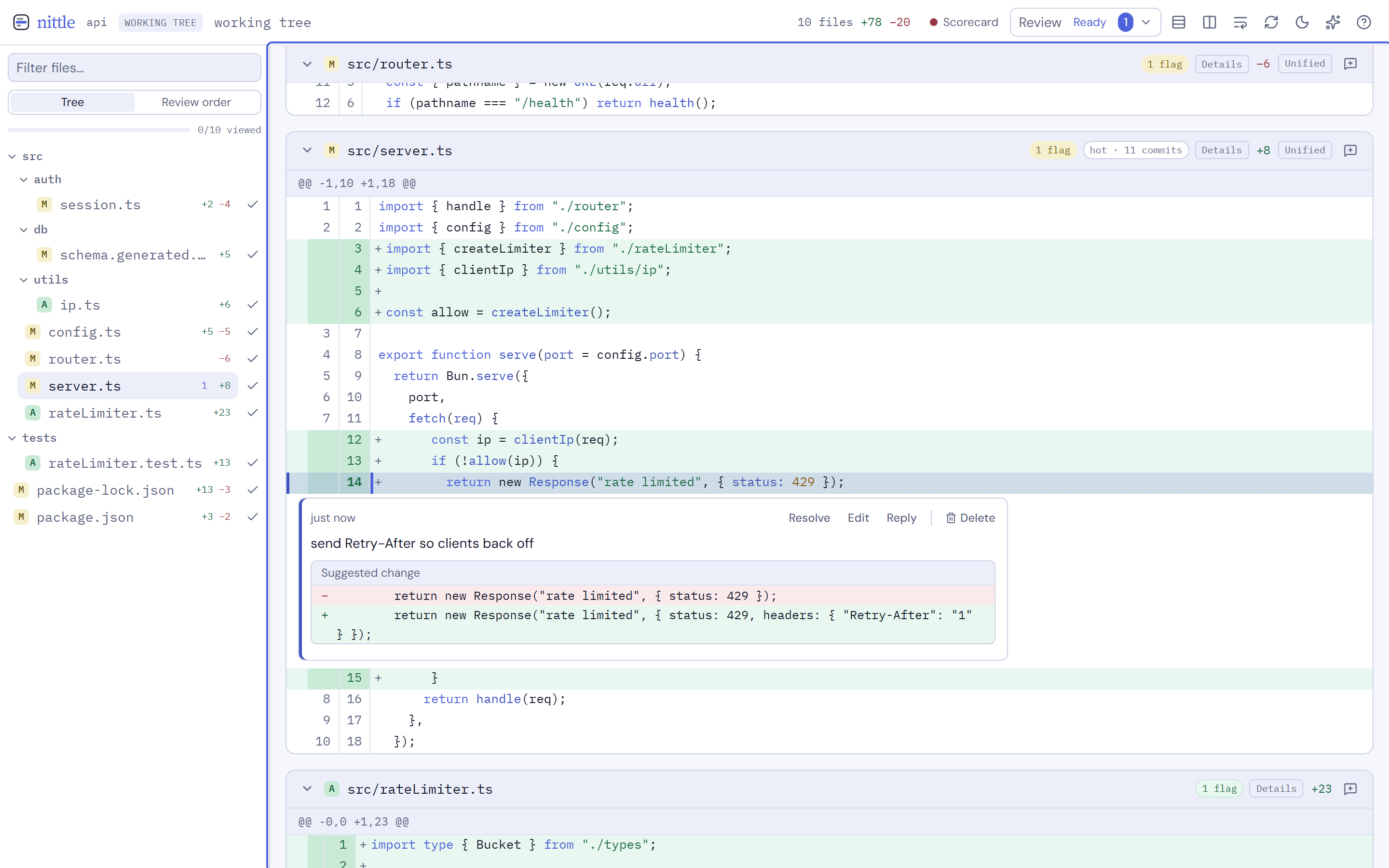
The saved comment shows each suggestion as a small diff titled Suggested change: the current lines with −, your replacement with +. Prose around the fence renders as normal markdown.
Write the fence by hand
Section titled “Write the fence by hand”The fence is the one GitHub uses: three or more backticks followed by suggestion, the replacement lines, then a closing fence of at least the same length.
- An empty fence means delete the lines. The card says “These lines would be deleted.”
- One comment can hold several fences. Each becomes its own suggestion for the same lines.
- If the replacement contains backticks, use a longer fence (four or more). The Suggest change button picks a safe length for you.
- Only a backtick fence counts. A
~~~suggestionfence, or a suggestion fence quoted inside another code block, stays plain text. - A fence with no closing line is treated as plain text from that point on.
What the agent receives
Section titled “What the agent receives”Over MCP, get_review lists every suggestion in a suggestions array, one entry per fence:
{ "commentId": "c3", "path": "src/retry.ts", "side": "new", "startLine": 8, "endLine": 8, "original": [ " await sleep(100 * 2 ** attempt);" ], "suggested": [ " await sleep(Math.min(100 * 2 ** attempt, 1000));" ]}original and suggested are arrays of lines with indentation kept, and an empty suggested array means delete. The agent can apply it as a plain line replacement without parsing your comment.
In the compiled prompt (nittle --wait, Copy Markdown, the P preview), each fence expands in place into the lines it replaces and the lines to put there:
**[issue]** Cap the backoff so attempt 5 doesn't sleep for 1.6s.

Suggested change to src/retry.ts, line 8:
ORIGINAL```      await sleep(100 * 2 ** attempt);```
SUGGESTED```      await sleep(Math.min(100 * 2 ** attempt, 1000));```
A delete reads SUGGESTED (delete these lines) over an empty block. The full prompt this came from is in Agent feedback.
Where suggestions don’t work
Section titled “Where suggestions don’t work”The button only appears for comments on the new side of the diff. Comments on removed lines and file-level comments don’t get it. A fence you type into a file-level comment by hand stays exactly as written in the card and the prompt, and isn’t listed in get_review.
A range has to sit inside the diff with no gaps. If you select lines from two hunks, the unchanged lines between them aren’t in the diff, so nittle has no text to replace. The button is disabled and the comment box says:
this range spans unchanged lines that are not in the diff, so it cannot carry a suggestion; comment on lines inside one hunkIf such a comment already holds a fence, the prompt adds (Suggestion not expanded: ...) with the same reason, and get_review leaves it out of suggestions and reports it in suggestionsError as comment <id> (<file> <start>-<end>): ....
original is read from the diff at the moment the agent asks, by line number. If the code under the comment changed after you wrote it, original shows the lines that are there now. Check the card before you send feedback on an old comment.
Resolved comments drop out of both the prompt and suggestions, along with any comment whose lines left the diff.